INRS and the Pasteur Network bring together scientists from 25 countries in Quebec to strengthen the fight against pandemics
FrançaisHeld in North America for the first time, the Pasteur Network Annual Meeting will explore the potential of artificial intelligence and emerging technologies.
PARIS and LAVAL, QC, Oct. 27, 2026 /CNW/ -- The Institut national de la recherche scientifique (INRS) and the Pasteur Network will bring together specialists in infectious diseases, public health, and biomedical research from 25 countries in Laval, Québec, from November 3 to 5, 2026, for the Pasteur Network Annual Meeting (PNAM).
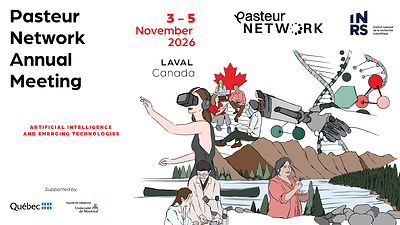

Held in North America for the first time, this international gathering will explore the potential of emerging technologies, including artificial intelligence (AI), to strengthen pandemic preparedness. It will bring together leading specialists and scientific leaders to discuss the tools and collaborations needed to address future infectious disease threats.
"INRS is honoured to co-organize and host this major international gathering in Québec. Pandemics and infectious diseases know no borders. By bringing together scientists from around the world in Laval, we are creating a unique forum to share knowledge, strengthen collaborations, and advance innovative solutions that will help better protect populations against future health threats," said Luc–Alain Giraldeau, Chief Executive Officer of INRS.
Over three days, ten sessions and four roundtables will explore how AI and emerging technologies can help detect, interpret, and respond more rapidly to infectious disease threats. Discussions will focus on epidemic intelligence, which transforms surveillance data into decision-support tools, pathogen genomics, the accelerated development of vaccines, therapeutics, and diagnostics, and the complex interactions between human, animal, and environmental health that underpin the One Health approach.
Participants will also examine the ethical, governance, and equity dimensions of the growing use of AI in research and public health.
PNAM 2026 highlights
- Specialists in infectious diseases, public health, and biomedical research from 25 countries;
- Ten sessions and four roundtables dedicated to artificial intelligence and emerging technologies;
- Discussions on epidemic intelligence, pathogen genomics, and the development of new medical countermeasures;
- A focus on ethics, governance, and equity considerations related to the use of AI;
- A session highlighting the work of early-career researchers on AI and emerging technologies;
- A forward-looking discussion on the future of scientific research towards 2030;
- An international leadership training program for the next generation of scientists.
"The Pasteur Network brings together institutions that share a common ambition: putting science to work for global health. PNAM 2026 will offer a unique opportunity to harness the expertise across our network to accelerate innovation and strengthen our collective capacity to address global health challenges: from infectious diseases to emerging health threats and other pressing public health priorities," said Mario Moreira, President of the Pasteur Network.
The Pasteur Network is an alliance of 33 research, innovation, and public health institutions across five continents. Many of its members play a key role in infectious disease surveillance, biomedical research, and epidemic preparedness.
Hosting PNAM 2026 marks an important milestone in the development of the Pasteur Network in Québec. A member of the Network since 2005 through its Armand-Frappier Santé Biotechnologie Research Centre, INRS expanded its membership in 2026 to include all of its research centres. The same year, the Faculty of Medicine at Université de Montréal joined the Network as an Associate Member under INRS sponsorship, further strengthening the Pasteur Network's presence in North America.
NOTE TO THE MEDIA: Interviews can be arranged prior to the event (upon request) and on site at the Sheraton Laval and Convention Centre, with spokespersons from INRS, the Pasteur Network, and participating scientists.
About INRS
The Institut national de la recherche scientifique (INRS) is a university dedicated exclusively to research and graduate training in strategic sectors in Québec. Since its founding in 1969, it has actively contributed to Québec's economic, social, and cultural development. INRS ranks 1st in Québec for research intensity. It is made up of five interdisciplinary research and training centres, located in Québec City, Montréal, Laval, Varennes, and Charlevoix, which focus their activities on strategic sectors: Eau Terre Environnement, Énergie Matériaux Télécommunications, Urbanisation Culture Société, Armand-Frappier Santé Biotechnologie, and Ruralités durables. Its community includes nearly 1,500 students, postdoctoral fellows, faculty members, and staff.
About the Pasteur Network
The Pasteur Network is an alliance of more than 30 organizations that plays a crucial role in tackling global health challenges through science, innovation, and public health. Its strength lies in the diversity and broad geographic reach of its members, spread across 25 countries on five continents and united by shared values and missions in service of populations, fostering a dynamic community of scientific knowledge and expertise that is both locally rooted and globally connected (pasteur-network.org).
SOURCE Institut National de la recherche scientifique (INRS)

Media contact (Pasteur Network), [email protected], +33 6 51 93 26 96; Media contact (INRS), [email protected], 514 971 4747
Share this article