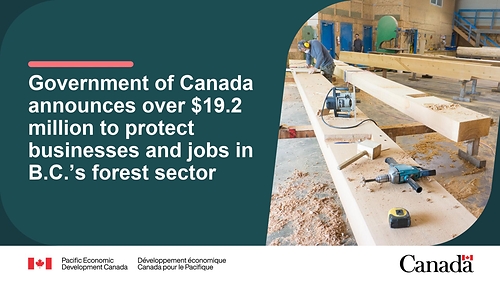
Government of Canada announces over $19.2 million to protect businesses and jobs in B.C.'s forest sector
FrançaisTLA'AMIN NATION, BC, Nov. 27, 2026 /CNW/ -- For generations, the forest sector has been a cornerstone of British Columbia's economy, creating good jobs, supporting regional supply chains, and sustaining communities across the province. However, tariffs and rapidly changing operating conditions are increasing costs, disrupting supply chains, and putting added pressure on forest-sector businesses and workers.
As trade pressures persist, the Government of Canada is protecting Canadian jobs by defending industries impacted by unwarranted U.S. tariffs. Delivered in B.C. by PacifiCan, the Regional Tariff Response Initiative (RTRI) helps tariff-impacted businesses manage financial pressures while they adapt to changing market conditions, strengthen their competitiveness and build greater trade resilience.
Today, the Honourable Tim Hodgson, Minister of Energy and Natural Resources, on behalf of the Honourable Gregor Robertson, Minister of Housing and Infrastructure and Minister Responsible for Pacific Economic Development Canada (PacifiCan), announced a $19.2 million investment through the RTRI for 16 forest-sector businesses across British Columbia. These investments will help businesses pivot to new pathways for growth, improve productivity, build more resilient supply chains, and address immediate operational needs.
This announcement includes an investment of over $960,000 in Island TimberFrame, a Vancouver Island business that turns B.C. wood into prefabricated structures and finished products such as stairs, doors and cladding. This investment will support upgrades to the company's manufacturing facility, including new wood processing equipment for structural and finishing applications, allowing Island TimberFrame to turn Canadian timber into finished, high-value wood products.
Minister Hodgson also announced the release of the first-ever comprehensive Forest Sector Strategy for Canada. The strategy outlines the Government of Canada's plan to maximize the value and sustainability of our forest assets and position Canada as a world-leading supplier of forest products for customers at home and abroad.
The Forest Sector Strategy for Canada includes the Forestry Regions Economic Diversification (FRED) initiative, a new $100 million national initiative that will help forestry-dependent communities plan for economic diversification and invest in projects that create new opportunities, strengthen local economies and build long-term resilience. In B.C., PacifiCan will deliver $22.1 million through the FRED initiative over three years. Interested organizations can now visit PacifiCan's website to learn more.
Through the RTRI, the Forest Sector Strategy for Canada and FRED, the Government of Canada is helping businesses and communities across the country weather global pressures, strengthen their resilience and build for long-term growth. By investing in B.C.'s strengths, PacifiCan is protecting jobs across the province and building Canada strong.
Quotes
"When B.C.'s forestry sector and businesses are under pressure, workers, families and entire communities across our province feel the impact. That is why we are helping to protect jobs while investing in greater productivity, new technologies and new markets. These investments will help build a stronger, more resilient forest sector and create opportunities for growth here at home and around the world."
-The Honourable Gregor Robertson, Minister of Housing and Infrastructure and Minister responsible for Pacific Economic Development Canada
"At this pivotal moment, business as usual is no longer an option for British Columbia's forest sector. For the first time, our Forest Sector Strategy sets a clear, comprehensive path forward to help the sector navigate today's challenges, while securing its future for generations to come. Through a historic investment and coordinated, strategic policy action, we are going to improve fibre supply certainty, accelerate innovation and modernization in the sector, advance Indigenous partnership, drive domestic demand for Canadian wood, and continue diversifying markets. Because a strong forest sector means a strong Canada."
-The Honourable Tim Hodgson, Minister of Energy and Natural Resources
"Tariffs have made it clear that we can't rely on a single market. With PacifiCan's support, we're investing in new wood processing equipment for structural and finishing applications that lets us take Canadian timber all the way to finished, high-value wood products right here on Vancouver Island. That means more of the value stays in B.C., our skilled team keeps building, and we can compete for customers in new markets around the world."
-Carl Tessmann, Partner, Island TimberFrame
Quick facts
- British Columbia is a major producer of softwood lumber and engineered wood products, and Canada's largest forest-product exporting province. In 2025, the province's forest sector generated almost $10.5 billion in exports, contributed $5.2 billion to Canada's real GDP and supported nearly 50,000 jobs (2024).
- The Regional Tariff Response Initiative (RTRI), delivered by Canada's regional development agencies, is part of the Government of Canada's strategy to defend Canadian jobs, industries and supply chains. It is part of a coordinated effort to protect Canadian businesses and workers from the impacts of tariffs.
- The RTRI provides $3.45 billion over four years to support small and medium-sized businesses impacted by tariffs to help them adapt to changing market conditions, strengthen their competitiveness, diversify into new markets, and build greater trade resilience with more flexibility to address operational pressures.
- Since September 2025, PacifiCan has approved $248 million through RTRI for 154 businesses across B.C. Across the country, regional development agencies have invested a total of $1.7 billion.
- The Forest Sector Strategy for Canada is Canada's plan for a competitive, sustainable and prosperous forest sector that continues to support communities, create jobs and provide world-class products to customers at home and around the world.
- This plan is supported by a proposed investment of $6.5 billion in Budget 2026, marking the largest federal investment in the history of Canada's forest sector.
- The Forestry Regions Economic Diversification (FRED) initiative is a $100-million national initiative delivered over three years. The initiative is part of the Government of Canada's national Forest Sector Strategy.
- The initiative is delivered through six of Canada's regional development agencies, including PacifiCan in B.C.
- The FRED initiative complements the RTRI. While the RTRI supports tariff-impacted businesses--including those in the forestry sector--address business impacts and adapt to changing market conditions, the FRED initiative is a community development initiative focused on the long-term economic diversification and resilience of forestry-dependent communities.
Associated Links
- PacifiCan
- Island TimberFrame
- Regional Tariff Response Initiative
- Forestry Regions Economic Diversification initiative
- Canada announces targeted countermeasures and substantive support for workers and businesses in response to U.S. tariffs
Stay connected
Follow PacifiCan on X and LinkedIn
Toll-Free Number: 1-888-338-9378
TTY (telecommunications device for the hearing impaired): 1-877-303-3388
SOURCE Pacific Economic Development Canada

Contacts: Soraya Lemur, Senior Communications Advisor and Press Secretary, Office of the Minister of Housing, Infrastructure and Communities, [email protected]; Lynsey Brothers, Communications Manager, PacifiCan, [email protected]
Share this article