A2GOLD INTERSECTS 141.10 G/T GOLD OVER 0.9 METRES AT SHALLOW DEPTH AT CASTLE AND DEFINES HIGH-GRADE STRUCTURAL TARGETS

HIGHEST-GRADE GOLD ASSAY REPORTED TO DATE AT EASTSIDE; RESULTS SUPPORT EMERGING STRUCTURAL MODEL FOR HIGHER-GRADE GOLD MINERALIZATION
TONOPAH, Nev., Sept. 21, 2026 /CNW/ -- A2Gold Corp. ("A2Gold" or the "Company") (TSXV: AUAU) (OTCQX: AUXXF) (FRA: RR7) is pleased to report assay results from diamond core drilling completed at the Castle Target, part of the Company's 100% owned, district-scale Eastside Gold-Silver Project in Esmeralda County, Nevada.
The program was designed to improve the Company's understanding of the geological and structural controls on gold mineralization at Castle and to test the potential for higher-grade mineralization within and beyond the current Castle mineral resource.
The results represent an important advancement in A2Gold's geological interpretation of Castle. In addition to the broad mineralized envelope that hosts the existing Castle resource, core drilling has identified discrete zones of higher-grade gold associated with interpreted structural corridors and favorable lithological contacts. These results provide the Company with a more focused geological framework for targeting higher-grade mineralization within and beyond the existing Castle resource, shifting the exploration emphasis toward structurally controlled higher-grade zones rather than simply targeting extensions of broad, lower-grade mineralization.
Highlights
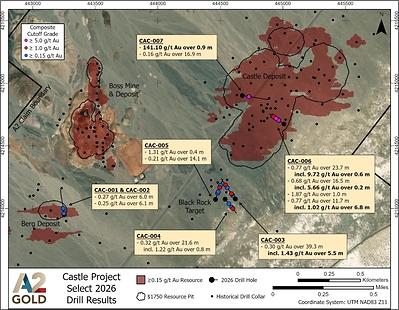
- CAC-007 intersected 141.10 g/t gold over 0.9 metres from 75.9 metres downhole, at approximately 53 metres vertical depth (Figure 1). This represents the highest-grade gold assay reported to date from the Eastside Project. The intercept occurs within the current Castle resource and is associated with an interpreted northeast-striking structural zone. The CAC-007 high-grade intercept occurs along the same broader northeast structural trend associated with previously reported high-grade surface channel samples at Black Rock, which include 10.50 g/t Au over 0.26 metres and 5.63 g/t Au over 0.28 metres. The approximately 400-metre corridor between Black Rock and the CAC-007 high-grade intercept remains incompletely tested and represents a priority target for follow-up drilling.
- CAC-006 intersected multiple high-grade gold intervals, including 9.72 g/t Au over 0.6 metres within a broader interval of 0.77 g/t Au over 23.7 metres, and 5.66 g/t Au over 0.2 metres within a broader interval of 0.68 g/t Au over 16.5 metres. These intervals occur near favorable lithological contacts within an interpreted northwest-trending structural corridor and provide additional evidence that higher-grade mineralization at Castle may be more extensive than previously recognized.
- The drilling supports an emerging geological model in which higher-grade gold mineralization may be controlled by northeast- and northwest-striking structures and favorable lithological/stratigraphic contacts, particularly where these features intersect.
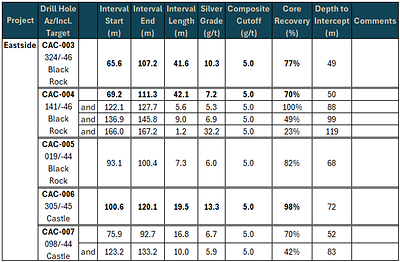
- The 2026 core program also identified broad zones of silver mineralization that were not systematically characterized by historical drilling, including 13.3 g/t Ag over 19.5 metres inCAC-006 and 10.3 g/t Ag over 41.6 metres inCAC-003. These results indicate that silver may represent a more significant component of the Castle mineralized system than previously recognized.
Figure 1: Plan view map that shows core holes completed during this program and significant intercepts
Peter Gianulis, CEO of A2Gold, commented:
"These results are important because they begin to change the way we think about Castle. Castle has historically been viewed primarily as a large, near-surface, lower-grade mineralized system. Our current exploration strategy is increasingly focused on identifying the structural controls that may host materially higher-grade gold within that broader system.
The 141.10 g/t gold intercept in CAC-007 is the highest-grade assay reported to date at Eastside and occurs only approximately 53 metres vertically below surface. Importantly, we do not view the CAC-007 result in isolation. Together with the high-grade surface mineralization previously identified at Black Rock along the same broader structural trend, it provides us with a specific corridor to systematically test for continuity of higher-grade mineralization.
Our next objective is straightforward: follow these structures, test the intersections between structural corridors and favorable stratigraphy, and determine whether these high-grade occurrences form part of continuous vein or feeder systems. That will be an important focus of the next phase of drilling at Castle."
Castle Core Drilling Results
The current drill program was designed to improve understanding of the structural and stratigraphic controls on gold mineralization. The program targeted key structural orientations and stratigraphic contacts identified through historical drilling and recent geological interpretation, with the resulting core enabling detailed characterization of lithological contacts, structural features, alteration and veining and their relationship to gold mineralization.
CAC-007 – Shallow High-Grade Gold
Hole CAC-007 intersected 141.10 g/t gold over 0.9 metres beginning at 75.9 metres downhole, approximately 53 metres vertically below surface.
The high-grade interval occurs within a broader zone of lower-grade gold mineralization including 0.16 g/t gold over 16.9 metres and is associated with a fault interpreted to strike northeast-southwest and dip to the northwest. This structure juxtaposes Tertiary volcanic rocks against Paleozoic sedimentary basement rocks.
Results from CAC-007 support the Company's interpretation that higher-grade mineralization may be structurally controlled and associated with the interpreted northeast-trending corridor at Castle. This structural orientation can now be systematically tested along strike and down dip to assess the continuity and scale of the higher-grade mineralization.
CAC-006 – Structural and Stratigraphic Controls
Hole CAC-006 intersected 9.72 g/t gold over 0.6 metres beginning at 71.0 metres downhole within a broader interval of 0.77 g/t gold over 23.7 metres, and 5.66 g/t gold over 0.2 metres beginning at 110.2 metres downhole within a broader interval of 0.68 g/t gold over 16.5 metres.
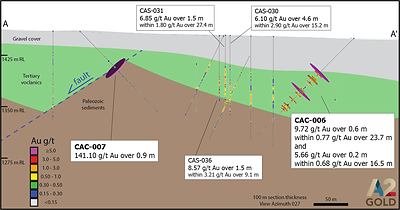
The higher-grade intervals encountered in CAC-006 (Figure 2) occur within broader zones of gold mineralization near favorable lithological contacts within the volcanic sequence and in proximity to an interpreted northwest-striking, steeply dipping structural corridor.
Figure 2: Northeast-looking cross-section A-A' showing CAC-006, CAC-007, historical drill holes and gold intercepts in relation to the interpreted northwest-southeast structural corridor (parallel to this section) and favorable stratigraphic contacts.
Geological Significance and Exploration Potential
The 2026 core program has refined the Company's geological interpretation of the Castle mineralized system and identified three potential controls on higher-grade gold mineralization (Figures 2 & 3).
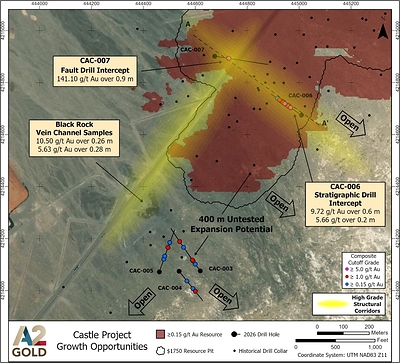
The first potential control is an interpreted northeast-striking, moderately northwest-dipping structural zone that juxtaposes Tertiary volcanic rocks and Paleozoic sedimentary basement rocks. CAC-007 tested this feature and returned the highest-grade gold assay reported to date at Eastside. High-grade vein samples previously collected and assayed from the Black Rock surface outcrop are also associated with this broader structural trend (Press Release dated June 3, 2026). The Company considers the corridor between Black Rock and CAC-007 and the projected extension of this structure to be a priority target for additional drilling.
The second potential control is an interpreted northwest-striking, steeply dipping structural corridor that transects the central Castle resource area. Offsets in lithology and mineralization observed in historical drilling, together with the distribution of the new higher-grade intervals, provide evidence that this corridor may influence the distribution of gold mineralization. Additional drilling will be required to establish its geometry and continuity.
The third potential control is favorable stratigraphy and lithological contacts within the overlying volcanic sequence and the contact with underlying Paleozoic basement. These contacts may have provided favorable pathways for hydrothermal fluids and sites for gold and silver deposition.
The Company's current interpretation is that higher-grade mineralization may preferentially occur where structural and stratigraphic controls intersect. The interpreted corridors extend through and beyond portions of the current Castle mineral resource, providing targets for additional drilling and potential resource expansion.
Figure 3: Plan map that shows the current Castle mineral resource, interpreted northeast- and northwest-striking structural corridors, and areas for potential resource expansion and follow-up drilling.
The 2026 core program has also identified broad zones of silver mineralization that were not systematically characterized by historical drilling, which predominantly reported only gold assays. Results include 13.3 g/t Ag over 19.5 metres in CAC-006 and 10.3 g/t Ag over 41.6 metres in CAC-003, indicating that silver may represent a more significant component of the Castle mineralized system than previously recognized. Systematic silver assaying in future drilling will improve understanding of silver distribution and its relationship to gold mineralization and provide additional data for consideration in future resource estimates.
Future drilling will build on these results and focus on infilling and extending the interpreted higher-grade trends within the current Castle resource, testing their projected extensions beyond the resource boundary, and evaluating their relationship to favorable stratigraphic contacts. Reinterpretation of historical drilling together with the new core data is underway to refine the structural interpretation and identify additional drill targets.
John Marma, Vice President, Exploration, commented:
"The objective is no longer simply to demonstrate that Castle contains a broad gold-mineralized system. The objective now is to understand where that system concentrates gold into significantly higher-grade zones. CAC-006 and CAC-007 support the interpretation that higher-grade gold is associated with specific structural orientations and favorable lithological contacts, with the strongest result occurring where these features converge. This provides a more focused framework for step-out and infill drilling along the interpreted structural corridors, including areas beyond the current Castle resource. The new silver results are also important, as they indicate that silver may represent a more significant component of the Castle mineralized system than previously recognized."
Mineral Resource Context
Castle hosts an existing NI 43-101 Inferred Mineral Resource. The current resource estimate comprises 19.986 million tonnes grading 0.49 g/t gold, containing approximately 314,000 ounces of gold at a 0.15 g/t Au cut-off grade. The resource estimate has an effective date of July 30, 2021.
The Company cautions that the results reported in this release have not been incorporated into the existing mineral resource estimate, and there is no assurance that the results reported herein or additional drilling will result in an increase to the mineral resource.
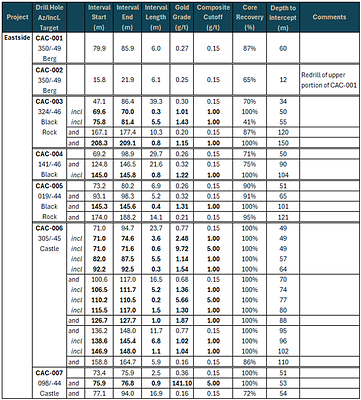
Table 1: Gold Assay Results from the 2026 Core Drill Program at the Castle Target
Table 2: Silver Assay Results from the 2026 Core Drill Program at the Castle Target
Gold Table Notes: Reported gold drill intercepts were calculated using a series of increasing cutoffs: 0.15 g/t gold cut-off grade with a nominal maximum of 4.0 metres of consecutive internal dilution; a 1 g/t gold cut-off grade with a nominal maximum of 3.0 metres of consecutive internal dilution; and a 5 g/t gold cut-off grade with a nominal maximum of 3.0 metres of consecutive internal dilution. No limit was applied to the total amount of non-consecutive internal dilution included within a composite. All reported intercepts begin and end with assays above the applicable cut-off grade. Composite intervals were calculated using uncapped raw assay values.
Silver Table Notes: Reported silver drill intercepts were calculated using a nominal cutoff of 5 g/t silver with a nominal maximum of 4.0 metres of consecutive internal dilution. No limit was applied to the total amount of non-consecutive internal dilution included within a composite. All reported intercepts begin and end with assays above the applicable cut-off grade. Composite intervals were calculated using uncapped raw assay values.
Reported intervals represent downhole drilled lengths; true widths have not yet been determined.
Core recovery was variable. Where applicable, reported intercepts containing incomplete core recovery were calculated using a length-weighted average grade of recovered core applied over the total interval. Consequently, some reported intercepts may contain intervals of core loss.
Quality Assurance / Quality Control
The core drilling program included the routine insertion of certified reference materials, blanks, and duplicates as part of the Company's quality assurance and quality control ("QA/QC") procedures. Drill samples were submitted to American Assay Laboratories in Sparks, Nevada, an ISO/IEC 17025 accredited analytical laboratory.
Gold analyses were completed using a 30-gram fire assay with an ICP-OES (optical emission spectrometry) finish. Samples exceeding the laboratory's upper detection limit are reanalyzed using gravimetric methods. Silver analyses were completed using a 5-acid digestion and an ICP-OES finish.
Qualified Person
John Marma, CPG, a Certified Professional Geologist with the American Institute of Professional Geologists and a Qualified Person as defined by National Instrument 43-101, has reviewed and approved the scientific and technical information contained in this news release.
About A2Gold Corp
A2Gold Corp. has built a multi-asset gold-silver exploration platform in Nevada, one of the world's premier mining jurisdictions. The Company controls approximately 230 km² of prospective mineral tenure across its Eastside and Taylor projects, both district-scale assets with large precious metals resources with significant exploration and resource growth potential.
Eastside hosts an inferred mineral resource of 1.4 million ounces of gold and 8.8 million ounces of silver*, while Taylor adds a highly prospective exploration district with gold, silver, antimony and porphyry-skarn upside. Backed by a fully funded exploration program and a strong pipeline of catalysts, A2Gold is focused on unlocking value through resource expansion, new discoveries and systematic district-scale exploration.
A2Gold is also supported by a strong shareholder base, including Kinross Gold Corporation, which owns approximately 9.9% of the Company's issued and outstanding shares.
* Updated Resource Estimate and NI 43-101 Technical Report, Eastside and Castle Gold-Silver Project Technical Report, Esmeralda County, Nevada," prepared by Mine Development Associates of Reno, Nevada, with an effective date of July 30, 2021. Pit-constrained Inferred Resources, using a cut-off grade of 0.15 g/t Au, total 61,730,000 tonnes grading 0.55 g/t Au and 4.4 g/t Ag at the Original Pit Zone, representing 1,090,000 ounces of gold and 8,700,000 ounces of silver, and 19,986,000 tonnes grading 0.49 g/t Au at the Castle Area, representing 314,000 ounces of gold, using a gold price of US$1,725/ounce. Mineral resources are not mineral reserves and do not have demonstrated economic viability. Inferred mineral resources are considered too speculative geologically to have economic considerations applied to them that would enable them to be categorized as mineral reserves.
On Behalf of the Board
Peter Gianulis, CEO
Neither TSX Venture Exchange nor its Regulation Services Provider (as that term is defined in policies of the TSX Venture Exchange) accepts responsibility for the adequacy or accuracy of this release.
Certain statements and information contained in this press release constitute "forward-looking statements" within the meaning of applicable U.S. securities laws and "forward-looking information" within the meaning of applicable Canadian securities laws, which are referred to collectively as "forward-looking statements." The United States Private Securities Litigation Reform Act of 1995 provides a "safe harbor" for certain forward-looking statements.
Forward-looking statements in this news release include, but are not limited to, statements regarding A2Gold's exploration plans for the Castle Target and Eastside Project; the interpretation of structural and stratigraphic controls on higher-grade mineralization; the potential continuity, scale and extension of higher-grade gold and silver mineralization; the potential for interpreted structural corridors to host continuous vein or feeder systems; planned follow-up, infill and step-out drilling within and beyond the current Castle mineral resource; potential resource expansion; the systematic evaluation of silver mineralization; the reinterpretation of historical drilling; and A2Gold's future exploration and development plans.
Forward-looking statements are statements and information regarding possible events, conditions or results of operations that are based upon assumptions about future economic conditions and courses of action. All statements and information other than statements of historical fact may be forward-looking statements. In some cases, forward-looking statements can be identified by the use of words such as "seek," "expect," "anticipate," "budget," "plan," "estimate," "continue," "forecast," "intend," "believe," "predict," "potential," "target," "may," "could," "would," "might," "will" and similar words or phrases, including negative variations, suggesting future outcomes or statements regarding an outlook.
Such forward-looking statements are based on a number of material factors and assumptions and involve known and unknown risks, uncertainties and other factors which may cause actual results, performance or achievements, or industry results, to differ materially from those anticipated in such forward-looking information. You are cautioned not to place undue reliance on forward-looking statements contained in this press release.
Some of the known risks and other factors which could cause actual results to differ materially from those expressed in the forward-looking statements are described in the sections entitled "Risk Factors" in A2Gold's Listing Application, dated January 24, 2018, as filed with the TSX Venture Exchange and available on SEDAR+ under A2Gold's profile. Actual results and future events could differ materially from those anticipated in such statements. A2Gold undertakes no obligation to update or revise any forward-looking statements included in this press release if these beliefs, estimates and opinions or other circumstances should change, except as otherwise required by applicable law.
SOURCE A2 Gold Corp

For more information contact: [email protected]
Share this article