L'Oréal-UNESCO For Women in Science Canada Program Celebrates Five Exceptional Canadian Scientists with Prestigious Awards
FrançaisMONTRÉAL, Nov. 25, 2026 /CNW/ -- The L'Oréal-UNESCO For Women in Science Canada program has named five women scientists as its 2026 laureates, in partnership with the Canadian Commission for UNESCO, the Natural Sciences and Engineering Research Council of Canada and the France-Canada Research Fund.
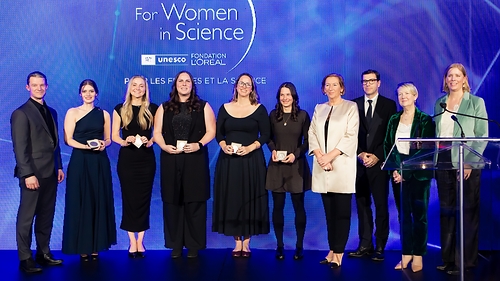
L'Oréal Canada has been deploying the For Women in Science program for 23 years in Canada. This esteemed initiative recognizes and supports groundbreaking research by women who are shaping the future of scientific discovery. The awards celebrate their dedication, innovation, and significant contributions across diverse fields of science.
The five scientists who are the 2026 Canadian L'Oréal-UNESCO For Women in Science recipients are:
- Hannah Braun | University of Saskatchewan | Advancing the Fight Against Antibiotic-Resistant Bacteria PhD Candidate, University of Saskatchewan Braun works in the field of molecular microbiology and protein biochemistry. Her doctoral research focuses on studying antimicrobial resistant bacteria. A major challenge of working with clinical isolates of antimicrobial resistant bacteria is the lack of molecular genetic tools available to study these bacteria in a laboratory setting. She has developed molecular toolkits to study secretion systems, which are machines assembled by bacteria to transport proteins out of the cell. Secreted proteins allow bacteria to survive in various environments and cause infections. Using these tools, she has identified several new secreted proteins. The next phases of her doctoral work will focus on defining the functions of these new proteins to determine if they are candidate targets for making new diagnostic tests or can be inactivated to treat infections. To complete this final phase, she plans to undergo a research exchange with a team of scientists in France who specialize in using physical chemistry to develop new diagnostic tools.
- Amanda Ricketts | Memorial University of Newfoundland | Modeling Surface Interactions for a Sustainable Human Presence on the Moon Ricketts' research focuses on improving our understanding of solar wind interactions with space-relevant surfaces using molecular dynamics simulations, knowledge essential to achieving a sustainable human presence on the Moon. To date, Amanda's doctoral research has focused on determining the surface binding energies (SBEs) of amorphous plagioclase feldspars and the coverage-dependent SBEs of adsorbed sodium atoms on plagioclase surfaces. Her current work extends these studies to hydroxylated and oxygen-depleted surfaces that represent space-weathered conditions. Building on this foundation, she aims to expand her research to operationally relevant materials used in lunar missions, investigating not only SBEs but also the evolution of mechanical properties as damage accumulates. These computational studies complement experimental investigations conducted by NASA collaborators, providing a more comprehensive understanding of surface processes in space environments.
- Dr. Sarah Sanderson | Université du Québec à Chicoutimi | Decoding Evolutionary Responses to Protect Freshwater Ecosystems Sanderson's research focuses on understanding how populations and ecosystems respond to human disturbances. At broad scales, she uses meta-analyses to identify general patterns in how populations respond to anthropogenic change. At finer scales, she studies freshwater fish populations of conservation significance to understand how human disturbances shape their contemporary evolution. A central goal of Sarah's research is to contribute to the long-term conservation of freshwater ecosystems by integrating evolutionary responses into conservation management. Currently, Sarah investigates how freshwater populations respond to human-driven environmental change. She integrates genomics to uncover the mechanisms that underpin adaptive potential, with a particular focus on how highly specialized populations of threespine stickleback can maintain the capacity for rapid evolution. In parallel, she examines how hydroelectric development and changing thermal regimes affect Atlantic salmon populations, with the goal of understanding how these populations respond to environmental change.
- Hallie Dau | University of British Columbia | Understanding how heavy menstrual bleeding impacts perimenopausal women in Uganda Dau is a Postdoctoral Fellow in the School of Population and Public Health at the University of British Columbia and the Women's Health Research Institute under the supervision of Dr. Gina Ogilvie. She is also a Canadian Institutes of Health Research Fellow. Hallie specializes in global women's health, specifically in Eastern Africa. Her postdoctoral research focuses on understanding the burden of heavy menstrual bleeding in low-resource settings. Her current study is funded by the Gates Foundation and will survey over 2000 women in rural Uganda about their menstruation experiences. She hopes that by bringing more awareness to this problem, policymakers can develop appropriate guidelines and support for women impacted. In addition to heavy menstrual bleeding, Hallie also manages several global cervical cancer screening projects in Eastern Africa. She and her team are committed to the World Health Organization's goal of cervical cancer elimination by 2030.
- Lauren Lawson | Carleton University | Protecting Aquatic Species at Risk from Urbanization and Salinization Lawson is an aquatic ecologist and conservation scientist based at Carleton University. She grew up exploring lakes and rivers, from Quebec's Laurentians to New York's Hudson River Valley. There, she saw firsthand how much people and wildlife depend on healthy freshwaters, and how easily legacies of pollution and development can weaken this connection. Lauren's PhD from the University of Toronto examined how winter road salt contamination in urban rivers affects freshwater species year-round. Her current research, in collaboration with partners at Fisheries and Oceans Canada, maps and quantifies threats to freshwater biodiversity across watersheds. A lifelong lover of maps, she sees them as a vital conservation tool because if we know where threats are concentrated, we can focus our threat mitigation efforts where they will make the most difference. Dedicated to service, Lauren is an Early-Career Researcher Editor at FACETS (Canadian Science Publishing) and a proud volunteer member of the Board of Directors at Watersheds Canada. She has participated in multiple mentorship programs and has represented young professional perspectives on freshwater, biodiversity, and intergenerational equity at international forums, including CBD COP15 and the 2023 UN Water Conference. Above all, Lauren is driven by hope: she envisions a future where Canada's lakes and rivers are managed as connected systems, with science, communities, and governments working together to safeguard freshwaters for generations to come.
During an awarding ceremony held last night under the high patronage of Hélène Farnaud-Defromont, Ambassador of France to Canada at the French Residence in Canada, Stéphane Bérubé, President and CEO of L'Oréal Canada said: "For 23 years, L'Oréal Canada has stood alongside UNESCO to champion the brilliance of women in science. I am immensely proud of what the For Women in Science Canada program has achieved over these two decades, not only in celebrating the exceptional women researchers who push the boundaries of knowledge, but in inspiring the next generation of girls to see themselves in a career in science. Every laureate we honour paves the way for the scientists of tomorrow. This is a commitment L'Oréal Canada will continue to carry forward with pride and determination."
The L'Oréal-UNESCO For Women in Science program, established in 1998, has supported more than 5,000 women scientists globally, recognizing their contributions to solving some of the world's most pressing issues. This program reflects L'Oréal's belief that the world needs science, and science needs women.
About L'Oréal Canada
L'Oréal Canada is a subsidiary of the L'Oréal Groupe, the world's leading beauty company. Headquartered in Montreal, the Canadian subsidiary, established in 1958, comprises a head office, a plant, and a distribution center, a sales office in Toronto, the ModiFace and SalonCentric subsidiaries, and employs over 2,000 people from more than 80 different nationalities. Its portfolio of 36 iconic brands is available across all distribution channels, including hair salons, department stores, mass market, pharmacies, medi spas, and e-commerce. Its purpose, to create the beauty that moves the world, defines its vision of beauty that is inclusive, ethical, generous, and responsible. With ambitious social and environmental commitments set out within the L'Oréal for the Future program, the subsidiary also actively supports the L'Oréal Foundation's programs such as L'Oréal-UNESCO For Women in Science. Through its various programs and partnerships, L'Oréal Canada and its brands support over 110,000 Canadians annually. To learn more about our impact in Canada: www.loreal.ca.
About the Fondation L'Oréal
The Fondation L'Oréal supports and empowers women to shape their future and make a difference in society. It focuses its action on two main areas: science and inclusive beauty.
Science: encouraging women's scientific excellence and inspiring future generations.
The Fondation L'Oréal is committed to supporting women scientists at every stage of their careers, from sparking vocations at a young age to recognizing excellence in established researchers. This commitment translates into an intergenerational approach and dedicated programs. In partnership with UNESCO, Fondation L'Oréal has run the For Women in Science program since 1998. This program aims to accelerate the careers of women scientists, remove the obstacles they face, and inspire younger generations to embrace scientific careers. To date, the program has supported more than 5,000 researchers from over 140 countries, promoting scientific excellence and encouraging many young women to pursue scientific studies. The Fondation L'Oréal, together with UNESCO, also invests in the future of women in science through the For Girls in Science program. This program aims to inspire scientific vocations in young girls by raising their awareness of the scientific challenges of tomorrow and introducing them to inspiring female role models. The goal is to support and encourage the next generation of female scientists, giving them the keys to succeed in scientific fields.
Inclusive Beauty: restoring self-esteem and promoting professional integration. Convinced that beauty contributes to the process of rebuilding lives, the Fondation L'Oréal helps vulnerable women to improve their self-esteem through free beauty and wellness treatments. These treatments help restore their self-esteem and help them regain confidence. At the same time, the Fondation L'Oréal promotes the professional integration of vulnerable women through excellent training in beauty professions. Since the program's founding in 2007, more than 200,000 women have benefitted from socio-aesthetics treatments, and more than 96,000 women have participated in the trainings.
About the Canadian Commission for UNESCO
The Canadian Commission for UNESCO (CCUNESCO) connects Canadians with the vital work of UNESCO--the United Nations Educational, Scientific and Cultural Organization. Through its networks and partners, it promotes UNESCO's values, priorities and programs in Canada, and amplifies the voices of civil society experts internationally. Its activities are guided by the United Nations 2030 Agenda for Sustainable Development and UNESCO's other priorities. CCUNESCO operates under the authority of the Canada Council for the Arts.
SOURCE L'Oréal Canada Inc. (Only Use For Wire)

For further information, please contact: Amélie Lafrance, L'Oréal Canada Corporate Communications Director, [email protected]
Partager cet article