Growing share of Canadians feel less confident about holiday spending: Money Mart survey
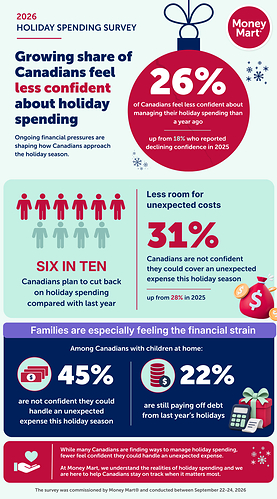
One in four Canadians (26%) feel less confident about managing their holiday spending than a year ago, up from 18 per cent who reported declining confidence in 2025.
Six in ten Canadians plan to cut back and more than half of those spending this season will not rely on savings alone
TORONTO, Nov. 19, 2026 /CNW/ -- Money Mart®, a leading provider of alternative financial services, today released its second annual Holiday Spending Survey, revealing that Canadians are heading into the season with less confidence in their holiday budgets than they had a year ago. More than one in four (26%) say they feel less confident about managing their holiday spending than they did last year, up from 18 per cent in 2025. Nearly a third (31%) aren't confident they could handle an unexpected expense over the holidays. Inflation, trade tensions and everyday costs are all shaping how Canadians plan for the holidays.
Key Findings
- 26% of Canadians say they feel less confident about managing their holiday spending than they did a year ago, up from 18% who said the same in 2025. That rises to 33% among those aged 35 to 54 and 34% among those with children at home.
- Nearly a third (31%) of Canadians are not confident they could handle an unexpected expense this holiday season, up from 28% in 2025. That rises to 45% among those aged 35 to 54 and 45% among households with children at home.
- Half (51%) of Gen Z feel pressure to spend more than they can afford during the holidays, compared with 37% of Canadians overall.
- Among Canadians who have borrowed money during previous holiday seasons, more than one in four (27%) say they have felt judged for it. That rises to 37% among those aged 18 to 34.
- For the second year in a row, 78% of Canadians expect inflation to affect their holiday spending. Meanwhile, 60% expect to cut back compared to last year, with that figure rising to 67% among households earning under $50,000.
- 64% say Canada-U.S. tariffs and trade tensions will affect how much they spend, and 63% plan to make more of an effort to buy Canadian this season.
- Among those planning to spend, fewer than half (45%) will rely mainly on savings. The remaining 55% expect to use credit cards, alternative financial tools or a combination of sources.
- 22% of Canadians with children at home are still paying off debt from last year's holidays.
- 78% are likely to wait for seasonal sales rather than pay full price, and 58% are likely to give fewer gifts.
Confidence slips as costs stay high
After another year of high costs, the strain is starting to show in how Canadians feel about the holidays. For the second year in a row, nearly eight in ten (78%) expect inflation to affect what they spend, and ongoing tariffs and trade tensions are adding to the pressure, with 64 per cent saying tariffs and trade tensions will affect how much they spend. Overall budgeting confidence has also edged down from 81 per cent last year to 79 per cent. The share who feel much less confident about managing their holiday spending than the year before rose from seven per cent in 2025 to 12 per cent. That shift is happening even though most Canadians are already cutting back where they can.
Canadians are making careful choices this holiday season
Most households still plan to celebrate this year, just on a smaller scale, and many are taking practical steps to keep holidays within reach. Seventy-eight per cent say they are likely to wait for seasonal sales rather than pay full price, while 58 per cent are likely to give fewer gifts. These choices show an effort to manage costs, even as many households worry about their ability to cover an unexpected expense.
Savings come first, but credit fills the gap for many
Savings are the most common way Canadians plan to pay for the holidays, but fewer than half of those planning to spend (45%) will rely mainly on them. The rest expect to use credit cards, alternative financial tools or a combination of sources. For many households, that means holiday costs will follow them into the new year, and for some, last season's already have.
Canadians aged 35 to 54, families and lower-income households feel the most strain
The squeeze is tightest for Canadians with the most to cover and the least room to spare. People aged 35 to 54, households with children at home and those earning under $50,000 are all more likely than others to feel less confident about their holiday spending and to doubt they could cover a surprise expense. For many families, last year's holidays aren't paid off yet, with more than one in five (22%) of those with children at home still carrying that debt.
The pressure to spend, and the stigma of asking for help
Financial strain can also come with social pressure. Half (51%) of Gen Z say they feel pushed to spend more than they can afford over the holidays, compared with 37 per cent of Canadians overall. Asking for help can carry a cost of its own: among Canadians who have borrowed money over past holiday seasons, more than one in four (27%) say they have felt judged for it. That kind of judgment adds stress at a time when many people are already stretched.
"Canadians are doing the work. They are shopping the sales, trimming their lists and putting savings first," said Peter Kalen, CEO of Money Mart. "What has changed this year is the cushion. Nearly a third tell us they are not confident they could absorb an unexpected cost over the holidays, and that number is moving in the wrong direction. When something does come up, people deserve a straight answer on what they can borrow and what it will cost before they commit, and service that's free of judgment. That is the part we can control, and it is what our teams focus on every day."
What Money Mart® is doing for customers
The holiday season can stretch budgets even further, and when unexpected costs come up, Money Mart® is there to help bridge the gap. Across approximately 360 Canadian branches, in-branch teams provide one-on-one support, including multilingual service in many communities. Through its prequalification process, customers can explore the options available to them without impacting their credit score. Money Mart® also reports repayment activity on its installment loans to credit bureaus, helping customers build their credit profiles through responsible repayment over time.
With so much to manage over the holidays, Money Mart's mobile app lets Canadians get the money they need quickly and easily, all from home. The application process is simple, with decisions made in real time. After approval, money can be sent within two minutes via e-Transfer. The app also offers 24/7 account management, along with clear information and a non-judgmental experience that helps customers make informed decisions.
Where to learn more
Visit moneymart.ca for tools, education and product details to help manage holiday costs.
Frequently Asked Questions
What is the Money Mart Holiday Spending Survey?
The Money Mart Holiday Spending Survey is an annual national study of Canadian adults that explores how Canadians plan to spend on and pay for the holiday season. Now in its second year, the survey tracks how Canadians' confidence and spending plans have shifted since 2025.
Can Canadians afford an unexpected expense over the holidays?
Many are not confident they could. Nearly a third (31%) of Canadians are not confident they could handle an unexpected expense this holiday season, up from 28 per cent in 2025. That rises to 45 per cent among Canadians aged 35 to 54 and 45 per cent among households with children at home. Confidence in their ability to budget and manage their spending also slipped, from 81 per cent last year to 79 per cent.
Are Canadians more or less confident about holiday spending than last year?
Twenty-six per cent of Canadians feel less confident about managing their holiday spending than last year, up from 18 per cent in 2025. The share feeling more confident fell from 21 per cent to 17 per cent. The picture also varies by region.
How is inflation affecting holiday spending in 2026?
For the second year in a row, 78 per cent of Canadians expect inflation to affect their holiday spending. Six in ten (60%) expect to cut back compared to last year, and 78 per cent are likely to wait for seasonal sales rather than pay full price. Fifty-eight per cent are also likely to give fewer gifts.
How do Canadians expect tariffs to affect their holiday shopping?
Sixty-four per cent of Canadians say ongoing Canada-U.S. tariffs and trade tensions will affect how much they spend this holiday season, and 63 per cent plan to make more of an effort to buy Canadian products than last year.
How much do Canadians plan to spend on the holidays?
Among those planning to spend in each category, 58 per cent expect to spend less than $500 on gifts, 68 per cent on travel and 83 per cent on entertaining.
How will Canadians pay for their holiday spending?
Among those planning to spend, 45 per cent will rely mainly on savings, 29 per cent will use a combination of savings and credit cards, and 18 per cent will rely on credit cards paid off over time. Eight per cent plan to use alternative financial tools, either alone or alongside credit cards.
Which Canadians are feeling the most holiday financial pressure?
Canadians aged 35 to 54 are the most likely to feel less confident about holiday spending (33%), along with those with children at home (34%) and households earning under $50,000 (32%). More than one in five (22%) Canadians with children at home are still paying off debt from last year's holidays. By region, Atlantic Canadians are the most likely to feel less confident about holiday spending (31%). Half (51%) of Gen Z also say they feel pressure to spend more than they can afford over the holidays, compared with 37 per cent of Canadians overall.
Do Canadians feel judged for borrowing money over the holidays?
Some do. Among Canadians who have borrowed money over past holiday seasons, more than one in four (27%) say they have felt judged for it. That rises to 37 per cent of those aged 18 to 34 and 32 per cent of households earning under $50,000.
How is Money Mart helping Canadians manage holiday costs?
Money Mart serves customers through approximately 360 branches in Canada and over 60 in the U.S., as well as a mobile app that lets Canadians get the money they need quickly and easily, all from home. The application is simple, decisions come in real time and, once approved, money can be sent within two minutes via e-Transfer. The app also offers 24/7 account management. Through its prequalification process, customers can see what they may be eligible for without impacting their credit score, giving them greater visibility into their options so they can choose the solution that best fits their needs.
About the Survey
These findings are from a survey commissioned by Money Mart® from September 22 to 24, 2026. The survey was completed by a representative sample of 1,503 online Canadian adults who are members of the Angus Reid Forum, in English and French. For comparison purposes only, a probability sample of this size would carry a margin of error of +/-2.53 percentage points, 19 times out of 20.
About Money Mart®
Founded in 1982, Money Mart® is a leading provider of financial services, serving customers across North America. In 2006, it acquired The Check Cashing Store® in Florida. Money Mart® is committed to creating a financial fresh start for customers, connecting them to money when they need it most. Financial products include short and long-term personal loans, cheque cashing, money transfers, currency exchange and the Titanium+® Prepaid Mastercard® (available in Canada). Money Mart® empowers individuals and families with accessible, flexible financial tools tailored to their needs. With approximately 360 locations in Canada, over 60 locations in the United States and a commitment to the communities it serves, Money Mart® is here to help when it matters most.
Correction: An earlier version of this release incorrectly included the infographic in French.
SOURCE National Money Mart Company

Media Contact: Alexandra Shinnan, Talk Shop Media, [email protected], 204-558-2025
Partager cet article