Amid tax system scrutiny, 51% say Productivity Mega Deduction will encourage new capital investment
TORONTO, Oct. 28, 2026 /CNW/ -- Canadian business leaders want this year's federal budget to execute on the government's agenda and build projects faster, attract more investment and enact reforms to help transition the economy. A new KPMG Canada survey finds 42 per cent of businesses identified accelerating major projects and reducing regulatory burden ‒ including for infrastructure and trade corridors ‒ as the top priority for the upcoming budget.
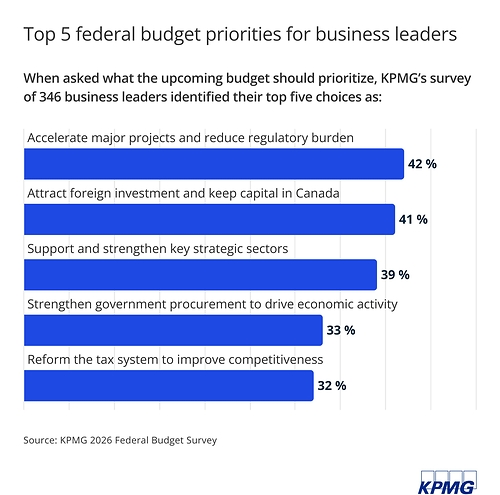
Investment is also high on the business agenda, with 41 per cent calling for measures to attract foreign investment and keep capital in Canada, while 39 per cent want greater support for key strategic sectors such as energy, critical minerals and advanced manufacturing. Half (51 per cent) also say the federal government's signature Productivity Mega Deduction will encourage new investment.
"Businesses are sending a clear signal that getting major projects moving is critical to Canada's growth and competitiveness," says Kaytlyn Barber, Partner and National Leader, Infrastructure, Capital Projects and Sustainability, KPMG Canada. "Canada has an opportunity to build the infrastructure and strengthen the strategic sectors that will support our economy for years to come. But the government can't do it alone. Corporate Canada has an important role to play, bringing investment, expertise and ambition to help turn these opportunities into economic growth."
Business Priorities for Budget 2026
"An unforgiving bond market is giving all advanced economies less fiscal room to maneuver right now, but Canada can still make important gains through structural changes that support its broader economic agenda," says Ali Jaffery, KPMG Partner and Chief Economist. "Streamlining regulations is a low-cost, effective way to improve the investment climate. And it's time to have a serious conversation about tax reform. The obvious place to start is on simplifying the tax system, reducing the complexity and bringing down compliance costs for businesses."
The poll revealed that 87 per cent support a comprehensive review of the tax system, 85 per cent want a simpler tax system, and 88 per cent believe the budget should provide stronger incentives to encourage investment.
Productivity Mega Deduction a catalyst for investment
The federal government's new Productivity Mega Deduction, estimated to cost $36 billion over five years, allows businesses to immediately deduct the full cost of a broader range of eligible investments. The survey findings indicate the measure will influence both the scale and timing of future investment decisions. When asked what impact the 'mega deduction' will have on their business investment plans over the next one to five years, business leaders responded:
- 51 per cent say it will encourage investment in new machinery, equipment, technology and capital projects
- 44 per cent say it will accelerate investments already under consideration
- 49 per cent say it will increase their investment in Canada
- 45 per cent believe it improves Canada's global investment competitiveness and attractiveness
The strongest support for the new deduction comes from capital-intensive sectors where large, direct investments are frequently required. Among respondents in the agriculture, automotive, construction and manufacturing sectors, 69 per cent say the measure would encourage new investment.
"The new Productivity Mega Deduction could make a real difference in investment decisions, particularly in sectors with upfront capital needs," says Lachlan Wolfers, National Leader, KPMG Law. "If a project is close to the line, improving the tax economics could be enough to move it forward. Our findings suggest the measure could not only affect how much businesses invest, but also how quickly they choose to do so."
Lower taxes come with a fiscal trade-off
More than half of respondents (52 per cent) want taxes lowered on capital and 49 per cent want a reduction in the corporate tax rate in order to boost competitiveness. However, there is less consensus on how government should make up for forgone revenues associated with lower taxes.
When business leaders were asked how major reductions in personal or corporate taxes should primarily be funded, reducing government operating spending ranked first, closely followed by using a mix of measures.
Additional findings:
- 35 per cent: Cutting government operational spending
- 32 per cent: A mix of raising consumption taxes, reducing government operational spending and borrowing
- 14 per cent: Curbing new government investments in 'nation-building'
- 11 per cent: Raising other taxes such as consumption taxes (e.g. the GST)
- 8 per cent: Increasing government borrowing
"These findings underscore how difficult the tax reform debate is in practice," says Brian Ernewein, KPMG Senior Advisor, National Tax. "While some proposals call for shifting more of the tax burden from income to consumption, there is no clear consensus among business leaders on how to fund lower taxes and offset lost government revenue."
About KPMG's 2026 Federal Budget Survey
KPMG Canada surveyed 346 Canadian business owners and decision-makers from September 22 to October 2, 2026. All respondents are members of the Angus Reid Forum. Of those surveyed, 21 per cent lead companies with annual gross revenue of $1 billion or more; 34 per cent, $500 million to under $1 billion; 10 per cent, $300 million to under $500 million; 16 per cent, $100 million to under $300 million; and 19 per cent, $10 million to under $100 million.
Among the companies represented, 57 per cent are privately held, 24 per cent are owned by private equity, 17 per cent are publicly traded, and 2 per cent are subsidiaries of foreign-owned companies. Forty-eight per cent of companies were headquartered in Ontario; 16 per cent in British Columbia; 15 per cent in Quebec; 11 per cent in Alberta; 6 per cent in Saskatchewan and Manitoba and 3 per cent in Atlantic Canada.
About KPMG Canada
KPMG LLP, a limited liability partnership, is a full-service Audit, Tax and Advisory firm owned and operated by Canadians. For over 150 years, our professionals have provided consulting, accounting, auditing, and tax services to Canadians, inspiring confidence, empowering change, and driving innovation. Guided by our core values of Integrity, Excellence, Courage, Together, For Better, KPMG employs more than 10,000 people in over 40 locations across Canada, serving private- and public-sector clients. KPMG is consistently ranked one of Canada's top employers and one of the best places to work in the country.
The firm is established under the laws of Ontario and is a member of KPMG's global organization of independent member firms affiliated with KPMG International, a private English company limited by guarantee. Each KPMG firm is a legally distinct and separate entity and describes itself as such. For more information, see kpmg.com/ca.
For media inquiries:
Nancy White
National Communications and Media Relations
KPMG in Canada
(416) 777-3306
SOURCE KPMG LLP

Partager cet article